The Faculty of Minor Disturbances
1. The Comet
An Introduction: A history of the Faculty was written by Edith Doove, although, as she points out, any suggestion that this is definitive or even relevant should be treated with caution (one version can be found here).
Members of the Faculty of Minor Disturbances meet fortnightly for one hour to develop collaborative projects that capture the spirit of pataphysical principles.
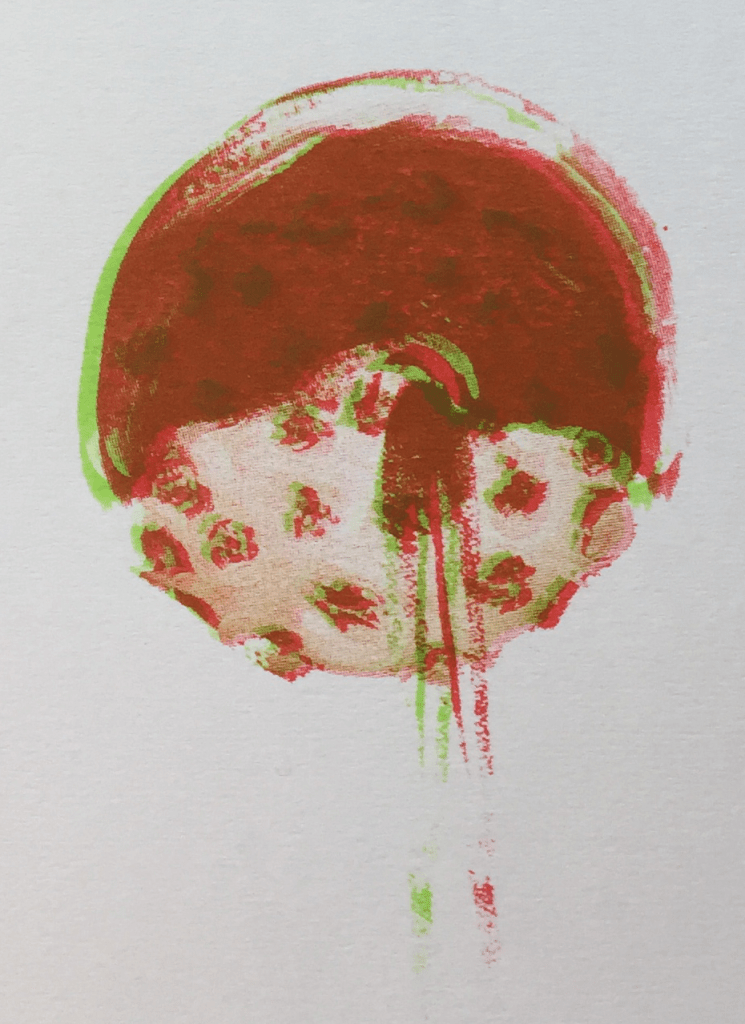
A founding project called ‘the comet’ (we used lower case to reflect our humility), was an art work designed to shake the universe. For this we invited a global community of about 250 artists to create a creative minor disturbance precisely at noon (12 GMT) on the 8th of December 2019. We asked them to take a moment and collaborate with colleagues, friends or other life forms to perform a creative act in their preferred form, shape, location, way of life and reality. We expected that this distributed act of creativity would adjust some of the wobbles in the planets. Attached to the invitation was one of 676 anaglyphic images which were produced by Rita Cachao of which a short contextualization of the process of developing these images and some examples are included in the special issue of Place – In/Between Places. Another of our ambitions was to build a collection of short stories rather as an exquisite corpse of accounts of insects boring their way through a pile of books. Intended to be seven stories all told, Michael Punt’s contribution The World Viewed: The Silverfish and the Broken Planets comprises a contribution to this project in the form of a non-human fiction and a video, Broken Planet, which documents an alternative (non-human) universe in keeping with his Impossible Orrery-series published in Place N°1.
The Faculty continues its underground work of disturbing and re-formulating the inner organs of academia with many more projects in progress. Some of these exist in a virtual realm (provisional histories, stories), others comprise what is generally accepted as matter (drawings, prints and objects etc.) and some of the best are great ideas that keep the Faculty busy. But the most important aspect of our collaboration is that creativity and decision making is collective and the concepts and forms of the outcomes are also distributed across material and so-called virtual platforms in a non-hierarchical fashion.
2. The Constellation
The Faculty embraces a number of discrete research bodies – mostly comprising individuals and their networks that share the broad topics, methods and approaches to new knowledge production. The Constellation has no research agency but provides the gravitational pull or the perceptual framework in which to see the pattern of research.
The Constellation will periodically produce an almanac in which basic information and useful data will sit alongside interesting thoughts in the form of abstracts, aphorisms and short extracts but, most of all, diagrams, images and, formulae exploring research.
Each entity in the Constellation has its own system of planets (i.e. network) which at times may intersect or simply support each other through their critical mass. If nothing else, The Constellation offers a substantial entity to resist the colonisation of individual talent.
3. The Asteroid
Accommodation on the Asteroid is a space projects and collaboration free but, so that we can plan events, participants must nominate the intended duration of their stay (6,12,18, 24 or 30 weeks) and commit to the programme offered during that period as research collaborators. The nominated duration can be repeated as required.
The Faculty of Minor Disturbances corrals in the Comet the work of: Rita Cachao, Edith Doove, Theo Humphries, Michael Punt, and Stephen Thompson.
The Constellation includes entities led by: Sue Denham, Hannah Drayson, Heidi Morstang, Mona Nasser, Claudy op Den Kamp. Its head office is aboard the vessel Ragdoll (wherever that may be in the ocean).
 Vagab(o/u)nds Research